In this first module, you will learn about the following:
- Intellectual and developmental disabilities (IDD)
- Mental health states
- The four parts of mental health
- Ways to increase mental health literacy
- Related glossary and resources
What Are Intellectual and Developmental Disabilities?

Disabilities are a natural part of the human experience. IDD are lifelong conditions that usually begin in early development, occurring before the age of 22. Intellectual and developmental disabilities affect the development of the brain and nervous system resulting in differences in areas of life such as speech and communication, movement, behavior and emotions, learning, or the body. These are distinct from acquired conditions, for example, from a car accident.
Examples of IDD include intellectual disability, autism, cerebral palsy, ADHD, and some genetic conditions such as Down syndrome.
IDD can affect a person’s physical, intellectual, communication, and emotional abilities.
- Intellectual disability includes aspects of learning, reasoning, remembering, and managing daily life in ways that are different from what is considered “typical.” In this curriculum, we approach ID from a strengths-based, not a deficit-based perspective. ID is not a fixed characteristic, nor does it define what a person cannot do. ID can be considered a gap between a person’s capabilities and supports; it should inform what supports a person needs to help them demonstrate their capabilities so that they can enjoy equal opportunity, full participation in their communities, independent living, and economic self-sufficiency.
- Developmental disabilities is a broader context that includes ID, but also includes other aspects of behaving, communicating, thinking, learning, and/or mobility.
IDD can be identified in early childhood or after a child enrolls in K-12 schools. Sometimes, individuals are identified with IDD by a medical professional before starting school. Other times, students are identified with IDD through school-based evaluations after demonstrating difficulties with learning. Many students with IDD receive support in school through an Individualized Education Program (IEP).
IDD can occur together or separately. People can be labeled with an intellectual disability, but not all people with developmental disabilities will be labeled with an intellectual disability.
Prevelance
In 2024, 134,686 of New Yorkers were served by the NYS Office for People with Developmental Disabilities.
| Disability Category | New York | National |
|---|---|---|
| Autism | 29.0% | |
| Cerebral Palsy | 3.3% | |
| Epilepsy/Seizure Disorder | 1.0% | |
| Intellectual Disability | 51.9% | |
| Other Developmental Disorders | 4.4% | |
| Other Neurological Impairments | 3.0% | |
| Unknown / Not Identified | 7.4% |
What is Mental Health?
Mental health includes our overall well-being, including emotional, behavioral, social, and psychological well-being. It affects how we think, feel, and act and how we handle stress, relate to others, and make choices in our daily lives. Our mental health can change over time, based on life events and other factors, which different mental health states.
Mental health states are how we experience mental well-being and mental distress.
We all have mental health states, including people with IDD.
We generally experience mental well-being as a positive state, and we generally experience mental distress as a negative state. These positive and negative states are not good or bad,; rather, they are natural states of being.
Our mental health can shift in response to things that happen or over time, but we can also experience mental well-being and distress at the same time!
Our mental health can be understood as having four main parts:
- Emotional well-being and distress
- Behavioral well-being and distress
- Social well-being and distress
- Psychological well-being and distress
Emotional Wellbeing and Distress
Our emotional well-being and distress are made up of our moods and feelings.
Feelings are reactions to something specific that happens or that you think about; they are usually short and specific. For example, you feel proud when you finish a project, or you feel disappointed when an event you were looking forward to is cancelled.
Moods are general feelings that last longer and are usually not tied to a specific thing that happens. Your mood can impact how you react to events and how intense your feelings are when things happen to you or when you think about things.
What types of moods or feelings do you experience as positive and part of mental health well-being?
These may include happiness, satisfaction, and a sense of hope.
Behavioral Well-Being and Distress
Our behavioral well-being and distress are mostly made up of our thoughts and actions, including how we respond to situations.
What types of thoughts and actions do you experience as positive and part of mental health well-being?
These may include taking part in activities that you enjoy, setting a goal and believing in your abilities, or choosing a plan and following through.
What types of thoughts and actions do you experience as negative and part of mental health distress?
These may include withdrawing from activities that you enjoy, being confused about goals and thinking you are not capable or experiencing challenges in matching your thoughts and actions to your goals.
Social Well-Being and Distress
Our social well-being and distress are made up of our communication and interactions with family, friends, our communities, and the larger social systems to which we belong.
What types of communication and interactions do you experience as positive and part of mental health well-being?
These may include enjoying talking, texting, or hanging out with people, playing a game or listening to music together, working together on a task, and feeling like you belong.What types of communication and interactions do you experience as negative and part of mental health distress?
These may include misunderstandings, conflict, or arguments when communicating with people, or being excluded, bossed around, overlooked in interactions with others, and feeling like you do not belong.
Psychological Well-Being and Distress
Psychological well-being and distress (from outline: which relates to self-actualization, development of potential, autonomy, and purpose) Our psychological well-being and distress are made up of our thoughts about ourselves and our lives, related to our self-actualization, our potential, autonomy, and purpose.
What types of thoughts about yourself and your life do you experience as positive and part of mental health well-being?
These may include feeling in control of your choices and your life, feeling good about who you are, or being able to adapt to changes.
What types of thoughts about yourself and your life do you experience as negative and part of mental health distress?
These may include doubting yourself, feeling overwhelmed or not having control of your life, or difficulty adjusting when things change.
These are all connected.
Emotional well-being and distress are the most immediate layers of mental health, a feeling or mood that happens in response to something.
Behavioral well-being and distress are how moods or feelings show up in our actions.
Social well-being and distress are our actions in our relationships with other people.
Psychological well-being and distress are how we see ourselves and our lives overall, shaped by our moods and feelings, our actions, and our relationships with other people.
Improving Our Mental Health
Knowing about the four parts of mental health helps us focus on what we can do to maintain or improve our mental health.
There are many things we can do to improve our mental health. Prevention is what we do before we experience mental distress, and resilience is what we do after we have experienced mental distress.
Prevention refers to the skills that can build to build and protect our mental well-being. Prevention may include taking care of our bodies through practicing quality nutrition, exercise, and sleep hygiene. It also includes protecting our well-being through engaging in relaxation and renewal, both alone and through social interactions.
Resilience refers to the skills we use to “bounce back” and recover when we experience challenges and mental distress. Resilience includes the strategies we use to manage stress, tolerate discomfort, and cope with hardship and setbacks. These can include practicing self-acceptance, engaging with social connections, and using mindfulness practices like drawing, journaling, breathwork, meditation, and listening to music.
What Is Mental Health Literacy and Why Does It Matter?
Mental health literacy means knowing about mental health and having the skills and resources to access and use that knowledge. By increasing your mental health literacy, you will begin to understand more about your own and others’ mental health.
You can also develop the skills to increase in your mental well-being and decrease your distress.
You can use these skills to become better able to communicate about your and others’ mental health, as well as identify and access mental health resources and supports to have better mental health outcomes.
All people experience mental health distress and challenges throughout their lifetimes. In the United States, 20% of the total population lives with a mental health condition. This percentage is much higher for people with IDD. Studies indicate that between 30% and 60% of individuals with IDD report experiencing mental health distress at any time. Module 3 will address this more in depth.
Therefore, it is important to assist people with IDD in accessing mental health supports and services AND to assist families, care teams, and professional practitioners in understanding the mental health needs of people with IDD.
People with better mental health literacy are more likely to seek help, access care, and experience better outcomes. This will also decrease stigma associated with both mental health and IDD and will increase mental health equity.
The nine modules of this curriculum build mental health literacy for people with IDD, their families and caregivers, and providers by covering foundational concepts like what mental health is, how identity and stigma impact well-being and practical skills, such as building resilience, recognizing warning signs, responding to crises, and navigating services. It equips individuals and the people who support them people with better mental health literacy are more likely to seek help, access care, and experience better outcomes, this curriculum equips individuals and the people who support them with the shared language, practical tools, and real-life examples (via video, transcripts, and print materials) needed to recognize mental health states, protect well-being, and get the right support at the right time.
The Importance of Language
Introductory paragraph here around both language from the field of counseling and the IDD field.
Additional Terminology
As we continue to learn about mental health and mental health literacy, there are a few more terms that will be useful.
Person-First and Identity-First Language
The language that we use to talk about IDD has changed over time. There are two common approaches used to refer to people with disabilities. Person-First Language puts the person before the label and is often used by parents and individuals with intellectual disability. Examples of person-first language include:
- A person with a disability
- Students with disabilities
- Sara has Down Syndrome
- John has autism
Identity-First Language is generally preferred by disabled adults and self-advocates. The idea behind identity-first language is that disability is an important part of the person’s identity, similar to race/ethnicity, gender, or sexuality. Examples of identity-first language include:
- A disabled person
- Disabled students
- Sara is Deaf
- John is autistic
When figuring out what language to use, it is important to respect the preferences of the individuals themselves. It is never wrong to ask people what they prefer.
Euphemisms and Ableist Language
Disability is not a bad word! When talking about disability, it is important to avoid Euphemisms, or words that mean “disability” without saying “disability.” Words and phrases like “differently abled,” “handicapable,” and “special needs” are often used instead of saying “disabled.” These words imply that being disabled is bad. Instead, we should just say what we mean. Disabilities are a natural form of human diversity. They are not “bad” or “good” and when we avoid saying the word “disability,” the implication is that it is something to be avoided, and therefore, is something bad.
Ableism is disability discrimination. Ableism shows up in our language when we use words connected to disability (such as lame, crazy, or slow) when we are talking about something we don’t like. Words like idiot, imbecile, moron, and retarded used to be medical terms for people with IDD and should never be used for any reason.
Mental Health Symptoms
Mental Health Symptoms can occur when our mental health well-being and distress are out of balance. When this happens, we may observe changes to our day-to-day mood, functioning, and interactions. While it is common to experience distress briefly, when mental health symptoms interrupt our lives, go on for more than a few days, or interfere with our relationships and connections, it can be helpful to seek mental health support and resources.
Identification of Mental Health Concerns
Identification of Mental Health Concerns related to mental health symptoms can be helpful so we can better match the supports to the challenges we are experiencing. Many care team members and providers have experience in mental health, and they can be a good point to support your self-reflection about your experiences and needs.
Licensed professionals are the only people qualified to assess mental health risks, evaluate, and provide mental health diagnoses. Often a mental health diagnosis is needed to access formal mental health services. These professionals often use the Diagnostic and Statistical Manual of Mental Disorders, Fifth Edition (DSM-5) to identify and diagnose mental health conditions. It describes the symptoms and criteria for each condition (like depression, anxiety, or schizophrenia) so that providers can consistently identify what someone is experiencing and figure out the right treatment or support.
It’s important to remember, however, that a mental health diagnosis does not define the person, and that people who share a mental health diagnosis do not all act or feel the same way.
Mental Health Treatment
Once a person accesses mental health treatment, they begin their work with a professional mental health provider. The mental health treatment may include counseling, which is sometimes referred to as therapy. The client (sometimes referred to as the patient) may see the provider alone, with their family, or with a small group of peers as other clients. It’s even possible to do more than one form of counseling, or to stop and start, sequencing them over time.
Most people who go to counseling report improvements to their mental health well-being and a decrease to their distress. Seeking mental health supports is linked to positive short-term Mental Health Treatment Outcomes. Long-term mental health treatment outcomes include increased prevention and resilience skills.
The Interrelationship of Mental Health States: Language Matters
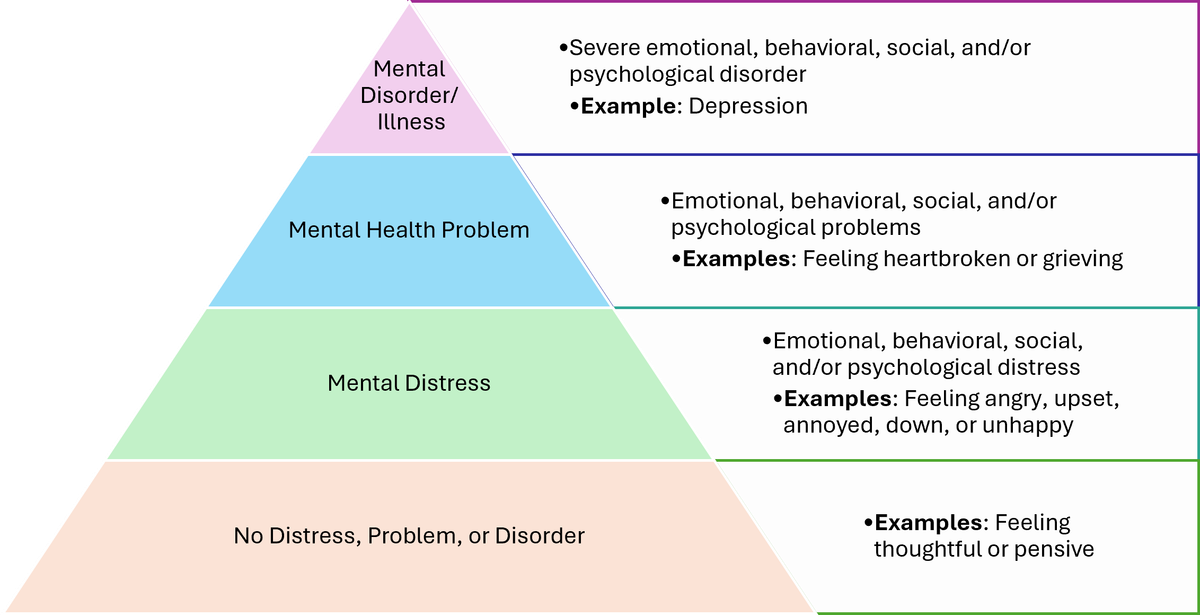
This diagram demonstrates the interrelationship between different the words used for different mental health states:
- Mental Disorder/Illness: Severe emotional, behavioral, social, and/or psychological disorder. For example, depression.
- Mental Health Problem: Emotional, behavioral, social, and/or psychological problems. For example, feeling heartbroken or grieving
- Mental Distress: Emotional, behavioral, social, and/or psychological distress. For example, feeling angry, upset, annoyed, down, or unhappy
- No Distress, Problem, or Disorder: for example, feeling thoughtful or pensive.